


Planewalker Is Reintroducing Humanity Into Psytrance Through the Celtic Harp

At the 2026 Winter Music Conference in Miami, one of the weekend’s most unexpected artists we had the pleasure of meeting wasn’t behind a wall of CDJs or modular gear. Seated between ancient tradition and modern electronic culture, Brennan Murphey, aka Planewalker, pulls melodies from the instrument that feels older than the dancefloor itself. Blending psychedelic bass, psytrance, live Celtic harp, and immersive stage design, Murphey is carving out a rare lane where electronic music reconnects with something deeply human.
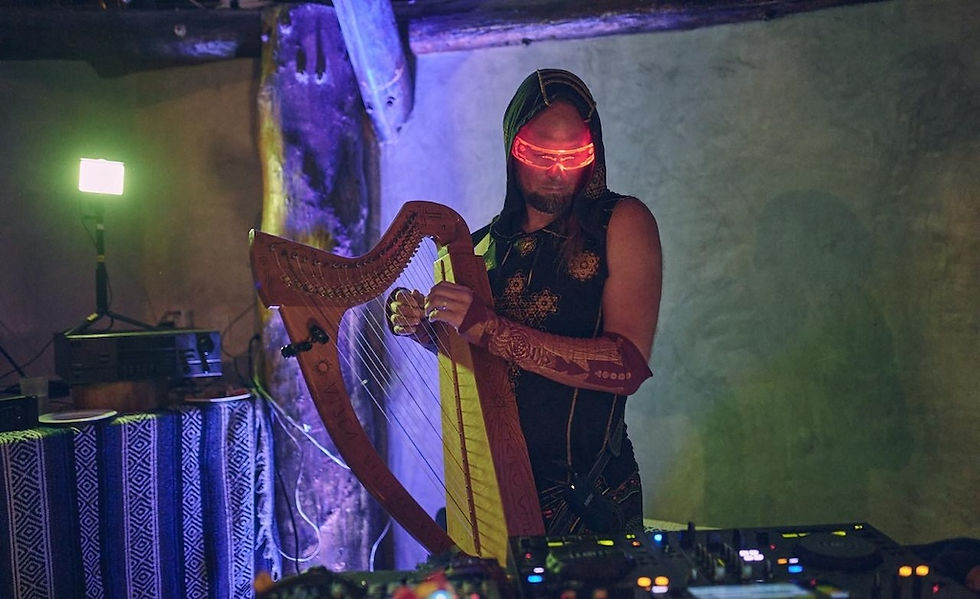
Brennan Murphey represents a growing shift in electronic music: a movement away from purely digital performance toward hybrid artistry. By blending traditional Celtic harp with psytrance structures and immersive live performance, Murphey challenges the idea that electronic music must be machine-first. As algorithms and overstimulation dominate our world, his works ask a different question entirely: what happens when dance music reconnects with memory, ritual, and human presence?
Long before the harp became his signature, Planewalker had already spent decades immersed in electronic music culture. Murphey began DJing in 1999 while attending college and started producing electronic music seriously in 2001. Since releasing his first vinyl in 2004, he has performed at festivals and clubs across North America, sharing stages with artists such as The Polish Ambassador, Desert Dwellers, Random Rab, David Starfire, and Rabbit in the Moon. His genre-spanning catalog pulls from psychedelic bass, glitch-hop, dubstep, and psytrance while maintaining a deeply organic identity rooted in live instrumentation and storytelling.
A Sound That Shouldn’t Work (But Does)
The pairing of a Celtic harp with psytrance might seem unusual at first: the gentle notes of the harp contrast sharply with the intense energy of psytrance. One represents tradition and healing, while the other embodies the vibrant atmosphere of modern electronic music. However, in Brennan Murphey's hands, this combination creates a unique blend that offers a refreshing escape from the overwhelm of our digital age.
The centerpiece of Murphey’s rig isn’t a standard MIDI controller, but a custom 23-string Celtic lap harp from Harps of Lorien. Unlike a guitar, where the player can bend and manipulate notes, the harp is a study in raw transparency. “You simply pluck the string and let it ring,” Murphey explains.
The harp serves as a melodic counterweight in a genre often driven by repetition and speed. Its presence forces space back into the music: chord progressions breathe longer, melodies linger, and emotion cuts through the intensity. Rather than burying the instrument beneath layers of production, Murphey builds around its imperfections and resonance.
The true magic comes from how he performs. To connect the seated folk tradition with an energetic electronic show, he modifies his harp to include a guitar strap, allowing him to wear the instrument while running the DJ setup. This inventive approach sparks admiration and curiosity about his live performance.
“This allows me to mix on a DJ rig with one hand while playing the harp with the other,” says Murphey. “By splitting my focus between both hands, I can execute some really cool transitions. I’ll play a melody on the harp with my right hand while my left hand messes around with the effects to glitch the sound out.”
The Harp as a Cultural Disruptor
Electronic music started by chance, using instruments like the Roland 303 and 808, which were not meant to be lead instruments. While electronic sounds can feel mechanical, incorporating handcrafted instruments, such as the Celtic harp, adds a human touch. Brennan Murphey's use of the harp may challenge genre conventions, but it also revives a cultural narrative and highlights the potential of traditional instruments to shape modern electronic music.
“Bringing a harp into a club environment definitely challenges people’s assumptions,” Murphey notes. “It has become a calling card for me because there isn’t another psytrance producer playing a Celtic harp over their tracks.”
That uniqueness has carried Planewalker from underground gatherings to internationally recognized stages, including Burning Man, Sonic Bloom, and immersive destinations such as the Papaya Playa Project in Tulum. His performances often extend beyond a standard DJ set, incorporating projection mapping, synchronized visuals, fire dancers, and live improvisation layered directly over his productions.

Combining a delicate wooden soundbox with a powerful sound system showcases both engineering and artistic skill. To ensure the harp can handle the noise of a club, Murphey opts for a smaller lap harp instead of a full-sized concert harp. This choice is intentional, as a larger instrument could lead to too much bass and unwanted feedback. To bridge the acoustics and digital worlds, he installed a piezoelectric pickup inside the harp. This requires careful equalization to ensure the strings are captured clearly without the soundbox absorbing excessive low-end feedback from the room.
Murphey views the harp as a connection to the real world amid the rise of AI and endless digital choices. While much of modern production seems like 'managing computer programs,' the harp offers a straightforward simplicity that reassures the audience of genuine, authentic music.
“The average listener doesn’t care about technical production tweaks; they either feel the music or they don't,” Murphey says. “The harp helps people ‘feel’ me. It keeps me from losing my stage presence to the algorithm… it keeps the music real.”
From Texas Country to Global Psytrance
Brennan Murphey translates his musical lineage into a new language, blending the storytelling roots of his upbringing. As the son of Michael Martin Murphey, a key figure in the progressive country movement, Brennan grew up immersed in music that emphasized narrative and tradition. However, he takes this legacy and propels it into new realms.
Drawing from his experience as a Celtic harpist in his father's band, Brennan acknowledges the importance of his heritage while intentionally forging his own path. He recognizes the connections between Irish folk and Western cowboy songs. Still, he translates those influences into a dynamic new context, electronic music at 145 BPM. “I’m a continuation of a musical legacy, but I’m evolving it,” Murphey explains.
Ambitiously, he remixes his father's work, such as “Dancing in the Meadow,” infusing bluegrass’s high energy into modern dance music. While his acoustic project, Tears of Joy, delves into his traditional roots, his 2017 full-length bass album, Planes of Consciousness, and his upcoming album, The King’s Chamber, explore the fusion of ancient melodies with psychedelic bass.

Brennan's approach is rooted in respect for tradition, yet unbound by it. He seeks to discover “noises no one else has heard before,” using the harp as his guiding star. This balance of honoring the past and pushing boundaries shapes his unique sonic identity as he crafts a distinctive musical language for the future.
“While I respect tradition, it can be limiting and repetitive,” says Murphey. “I prefer to push boundaries.”
Along the way, Planewalker has connected with influential underground labels and collectives including Desert Trax, Merkaba Music, Street Ritual, and Geomagnetic. His collaborations and remixes alongside artists like Desert Dwellers and Merkaba further position him within the evolving psychedelic bass movement.
Why Brennan Murphey Fits the Future of Dance Music
Brennan Murphey’s music transcends the typical dance culture landscape, existing far from the transactional nature of conventional clubs. Instead, he finds his home in wellness and intentional movement spaces, aiming to create immersive experiences that resonate emotionally and spiritually with his audience.
"My music is deeply spiritual and geared towards mind expansion," Murphey explains. He seeks a crowd that values the cerebral high of music over fleeting distractions. This approach is essential for fostering genuine connections amidst overwhelming stimuli and noise that often overshadow the communal essence of the dancefloor.
Murphey expresses concern about the disconnection prevalent at modern festivals, noting that the overwhelming volume and multiple stages can stifle authentic interaction. He advocates for creating spaces where individuals can bond genuinely, much like the "Chill Tent" of the 90s, where real connection thrives.
Ultimately, Murphey’s vision for the future of performance culture focuses on elevating the dancefloor as a ceremonial space, a sacred setting for shared experiences, storytelling, and emotional exploration. As he says, “The dancefloor will always be a ceremonial space,” reminding us of its profound cultural significance in fostering community and intentional artistry.
Planewalker rebalances technology by focusing on emotion, ritual, and human presence. Somewhere between the pulse of psychedelic bass and the resonance of 23 harp strings, Brennan Murphey is reminding electronic music of something it was never supposed to forget in the first place: connection, not just to the dance floor, but of each other.


Phần Top game bài đổi thưởng phỏng vấn Brennan Murphey nói về đàn harp Celtic và psytrance khiến tôi nhớ mấy bản nhạc không lời từng bật khi làm việc buổi tối. Tôi không rành dòng này, nhưng cách người nói giải thích sự giao thoa giữa hai thể loại khá dễ nghe. Nửa sau bài tôi đọc trên chuyến xe về, có người ngồi cạnh đang xem gì đó có tên Top game bài đổi thưởng. Tôi chẳng để ý nội dung, chỉ ngoái nhìn một chút rồi quay lại màn hình. Bài này làm tôi muốn nghe lại đoạn đàn mà anh ta nhắc tới, dù chưa chọn được bản nào.
Phỏng vấn thú vị ở chỗ người trả lời không tách bạch nhạc điện tử với psytrance mà kể như một dòng chảy. Tôi đọc bài này trong lúc ngồi làm việc buổi sáng, thói quen là để một album nào đó chạy nền cả buổi để tay không chạm vào điện thoại, nhưng sáng nào cũng mở Lô đề online xem một chút cho tỉnh táo rồi tắt hẳn. Nghe câu bàn về việc giữ âm thanh sống và tự sáng tác lại khiến tôi nghĩ đến việc giữ khoảng lặng trong một ngày làm việc, khó hơn nhiều so với giữ khoảng lặng trong căn phòng thu â.
Phần phỏng vấn này thú vị ở chỗ tác giả nói về đàn harp Celtic và psytrance trong cùng một mạch, dù nghe khá xa nhau. Mình không am hiểu nhạc điện tử, nhưng cách nhắc tới nguồn gốc âm nhạc rồi chuyển sang tương lai khiến mình thấy có sợi dây chung. Lúc đọc, mình nhớ có lần nghe Tài xỉu được đem ra bàn khi nói về thói quen nghe nhạc lúc rảnh của một nhóm bạn, chỉ là ví dụ về cách người ta tìm niềm vui nhanh trong lúc chờ việc. Mình vẫn chưa rõ ảnh hưởng của dòng nhạc tới khán giả trẻ.
Bài phỏng vấn này tôi đọc một mạch, không dừng lại. Điều thú vị nhất là chi tiết về nguyên lý chơi đàn Celtic và việc psytrance kéo từ thứ âm nhạc truyền thống đó sang một hướng khác hẳn. Trước đây tôi từng ngồi nghe một buổi tối rất khuya, tai nghe mỏng, bật nhạc để chờ ngủ, nên cũng tò mò xem qua mấy kênh chọn nhạc như 789club chỉ để nghe cho quen tai chứ không nghe kỹ gì cả. Bài viết không khoe tài năng, chỉ kể về hướng đi từ chỗ cũ sang chỗ mới, đó là kiểu chuyện tôi muốn đọc. Chỉ tiếc là phần về tương lai hơi chung chung, mong tác giả nói…
Cuộc phỏng vấn này đi từ đàn harp Gaelic sang psytrance rồi nói về hướng của nhạc điện tử, nghe hơi ngang nhưng thú vị. Mình không rành hai dòng nhạc đó, nên phần thảo luận về âm sắc và tiết tấu khiến mình phải đọc chậm lại. Trong lúc nghe nhạc chờ ngoài ban công, mình nhớ có người từng nói tới 789club - 50% như một chuyện để bàn cho vui, nhưng mình chỉ nhớ thoáng qua chứ không để ý kỹ. Trở lại bài, đoạn nói về tương lai cho thấy tác giả không xem nhạc điện tử như một thứ chỉ để chơi cho nhanh, đó mới là điểm mình nhớ nhất.