


Red Room: Where Techno, Art and Feminine Power Collide

Ashley Lazarz’s first solo exhibition transformed Cloud Three Studios into an immersive world of visual art, techno, and connection.
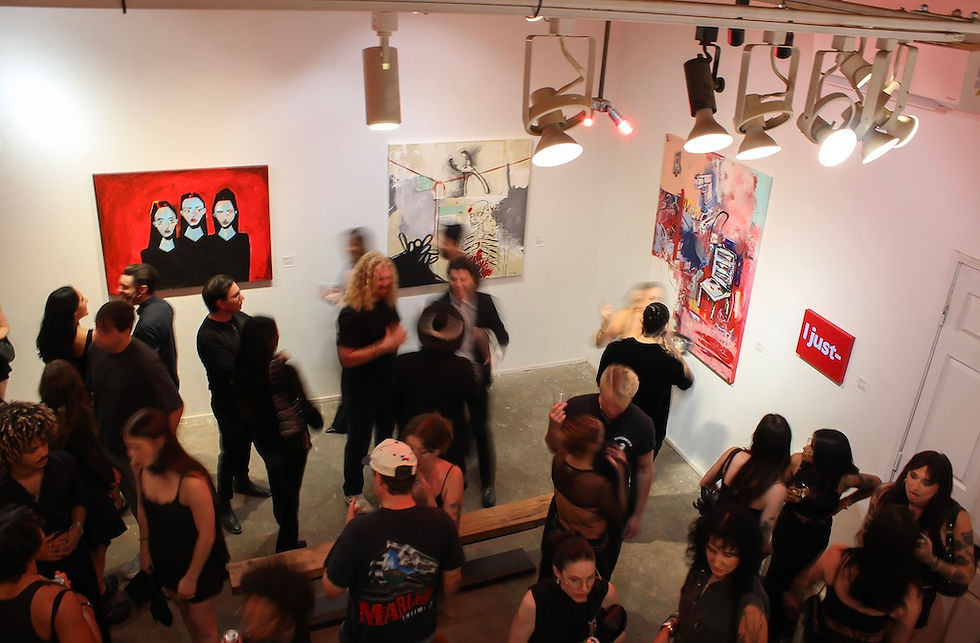
Walking into the Red Room at Cloud Tree Studios, I encountered a striking collision of elegance and underground energy.
The walls were covered in visual artist Ashley Lazarz’s work, punctuated by cherry red, vibrant lines and psychologically charged imagery inspired by her love of techno. The exhibition explored feminine power, emotional tension, intimacy, secrecy, danger, ritual and connection, with women throughout the work unapologetically reclaiming their own narratives.
Sommelier Lynn Becker and an array of reds and whites added an unexpected layer of elegance to the evening. As I took in the elevated combination of art and music, the room continued to fill.
I had the opportunity to sit down with Ashley and hear how the Red Room came to life. For her first solo exhibition, the event was designed to be immersive from the start - a gallery experience that would gradually transform into a full techno rave as the night unfolded.

The idea began at a late-night warehouse party. Surrounded by the grungy atmosphere, Ashley looked at the walls and thought, “I could have my paintings on these walls.”
From that moment, the Red Room began to take shape.
Ashley’s work reflects many of the same emotions she finds in techno. She described the collection as dramatic, sexy, chaotic and even angry, but in a way that ultimately feels freeing and positive.
Music is also woven directly into her creative process.While creating the exhibition, Ashley listened closely to Brutalismus 3000, letting its rhythm influence the physical movement behind her paintings. She even created one piece without a paintbrush, using her finger to move paint across the canvas.
That connection between sound and movement became a defining element of the Red Room.
When Ashley first told me about Cloud Tree Studios, she mentioned the red curtains. Once she walked into the space, she knew it was the right home for the exhibition. With its attention to detail, stage, existing red elements, and the venue’s hospitality, everything fell into place.
Then, at 10 p.m., the Red Room shifted from observation into movement.

Ashley intentionally built an all-female DJ lineup featuring Penny Lane and DEA, who traveled from Dallas for the event.
The paintings that had quietly surrounded the room were now part of a living environment, one where the crowd, the music, and art constantly interacted.
But one of my favorite moments of the night had nothing to do with the production, the paintings, or even the dance floor. I watched Penny Lane’s parents experience her DJ set for the first time. Both classically trained musicians, they stood in the crowd watching their daughter perform in a completely different musical world from the one they knew. It captured what Ashley had really built with the Red Room.
Yes, the event brought visual art and techno together. But it also created a space where different forms of creativity, generations and communities could meet. And that may be the most compelling part of the experience.
Ashley only began seriously calling herself an artist a little over a year and a half ago. Since then, she has already begun exhibiting her work, pursuing gallery opportunities, connecting with curators and creating immersive experiences of her own. Red Room feels like another step in that evolution because it demonstrated how naturally her different creative worlds can exist together.
Art became an atmosphere. Techno became a movement. And the gallery became a place where people could experience both at once. And by the end of the night, the Red Room had transformed into something audiences could do more than hear.
They could see it, feel it and become part of it.


Comments